Architecture Overview
Introduction
Viglet Shio is a single Spring Boot 4 / Java 21 application over a relational database. It holds one content model and exposes it through four surfaces: an agent protocol, a console API, a delivery API, and a page renderer, and every one of those is a shape over the same services rather than its own contract.
That constraint is the architecture's main idea. There is no separate agent backend, no second serialization, no third way to write a post. Adding a capability means adding it once, in the service, and projecting it where callers need it.
Nothing calls out to a hosted service: Shio holds no model and no prompts, and the content, the files and the keys stay on your infrastructure.
Component diagram

Two edges in that picture are the ones worth reading twice:
- MCP delegates to the agent surface, which delegates to the same write services the console uses. An agent is not a privileged path into the data; it is a different spelling of the same operations, with its own guards on top.
- Turing indexing is a dotted line. It is an opt-in integration reached on publish, not a component the system needs to run.
The surfaces
| Surface | Path | Auth | For |
|---|---|---|---|
| MCP | POST /mcp | API key (AGENT scope) | An agent's client: 12 tools, 6 resources, 4 prompts |
| Agent REST | /api/v2/agent/** | API key (AGENT scope), stateless | Discovery, addressed reads, atomic writes, verification |
| Console API | /api/v2/** | Session + CSRF | The React console |
| Delivery (CDA) | /api/v2/cda/**, /graphql | API key (read / preview / write scope) | Your own front end |
| Renderer | /preview/**, /sites/** | authenticated / anonymous | Pages Shio serves itself |
Core modules
| Module | Owns |
|---|---|
| Content | The unified post model, folders, sites, post types, the trash, versions |
| Agent | The manifest, context pack, address resolution, the op vocabulary, plan/apply, memory, diagnostics |
| Verify | The content lint, route proof, structural and appearance digests |
| Render | Template composition, the helper set, themes and tokens, link rewriting |
| Static files | Uploads, the image transform pipeline, byte delivery by id and by site path |
| Exchange | Site export/import packages, tenant provisioning |
| Security | API-token scopes, session auth, tenant resolution, CSRF and CORS |
Persistence
| Concern | How |
|---|---|
| Schema | Liquibase owns it. ddl-auto is none; an upgrade is a restart, not a hand-written ALTER |
| Databases | PostgreSQL, MariaDB/MySQL, or embedded H2 for development |
| Content model | One unified post row per state (DRAFT, PUBLISHED), over a JOINED inheritance hierarchy whose root carries the tenant discriminator |
| Multi-tenancy | A discriminator column on the shared schema, applied by a Hibernate filter: see Multi-Tenancy |
| File bytes | Under store/, addressed by post id and, for a site's own assets, by folder path |
The flows
The agent loop: discover, plan, write, verify
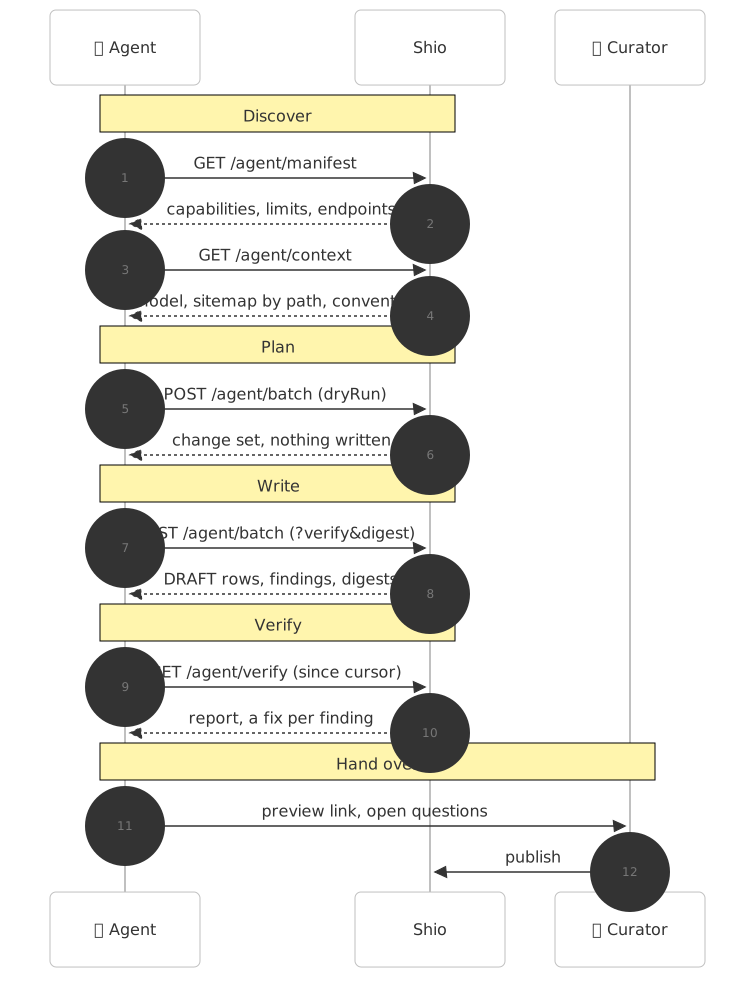
The plan step writes nothing, and the write step carries its own proof (?verify&digest),
so a task that would be a dozen round trips is three or four calls.
A curator's correction

Every arrow into PUBLISHED passes through a person. See
Letting an agent in.
A delivery read
The content-as-files round trip

The render pipeline

A replicated site being served

Technology stack
| Layer | Technology | Notes |
|---|---|---|
| Runtime | Java 21 | Minimum supported version |
| Framework | Spring Boot 4 | Application container, security, MVC, GraphQL |
| Database | PostgreSQL · MariaDB/MySQL · H2 | H2 for development; the schema is DB-agnostic and Liquibase-managed |
| Schema | Liquibase | ddl-auto=none; migrations are the source of truth |
| Template engine | Handlebars.java | No script engine on the classpath |
| Search | In-database full text; optional Viglet Turing client | Turing is off by default (shio.turing.enabled=false) |
| Cache | Hazelcast (embedded), HTTP ETag / Cache-Control, per-transaction render caches | |
| File extraction | Apache Tika | Text extraction from uploads |
| Console | React 19 + TypeScript + Radix UI + Tailwind + Vite | Built into the JAR |
| Packages | @viglet/shio-client, @viglet/shio-react-sdk, @viglet/shio, @viglet/shio-model, @viglet/shio-sections, @viglet/shio-editor-cors | pnpm workspace |
| Ops | Actuator, OpenAPI, Docker / Compose |
Two things earlier documentation listed as part of the stack are not: there is no server-side JavaScript engine (the Nashorn artifact is explicitly excluded from the build), and Elasticsearch is not a dependency: search runs in your database, and Turing is an optional client you enable if you want faceted enterprise search.
Deployment topologies
Development
One process, embedded H2, store/ on local disk. npx @viglet/shio and an agent client
against http://localhost:2710. The console is served by the same JAR; run Vite
separately only if you are changing the console itself.
Single node
Shio + PostgreSQL (or MariaDB/MySQL). This is the shape most installations want:
- What must be co-located with the process:
store/: the file bytes and logs. Put it on a volume that survives a redeploy. - What must not be: the database. The schema is migrated at startup, so a rolling restart is a migration.
- What is optional: a reverse proxy for TLS, and a CDN in front of
/sites/**(five minutes of cacheability, so a purge hook is worth wiring if you publish often).
Containers
docker compose with Shio, a database, and a volume for store/. Turing is a separate
compose service only if you enabled indexing.
Multiple nodes
Shio runs multi-node, with two things to know before you scale out: the CDA's rate limiter is per JVM, so a per-token budget is multiplied by your node count; and the change feed is commit-ordered per node, so a consumer walking it across a cluster is told when it has met a write the node it asked did not stamp.
Related Pages
| Page | Description |
|---|---|
| Core Concepts | The vocabulary this diagram uses |
| The Agent Surface | The protocol the agent edge speaks |
| Pages, Layouts & Regions | The renderer, in full |
| Multi-Tenancy | One JVM, many isolated tenants |
| Installation Guide | Getting the topologies above running |